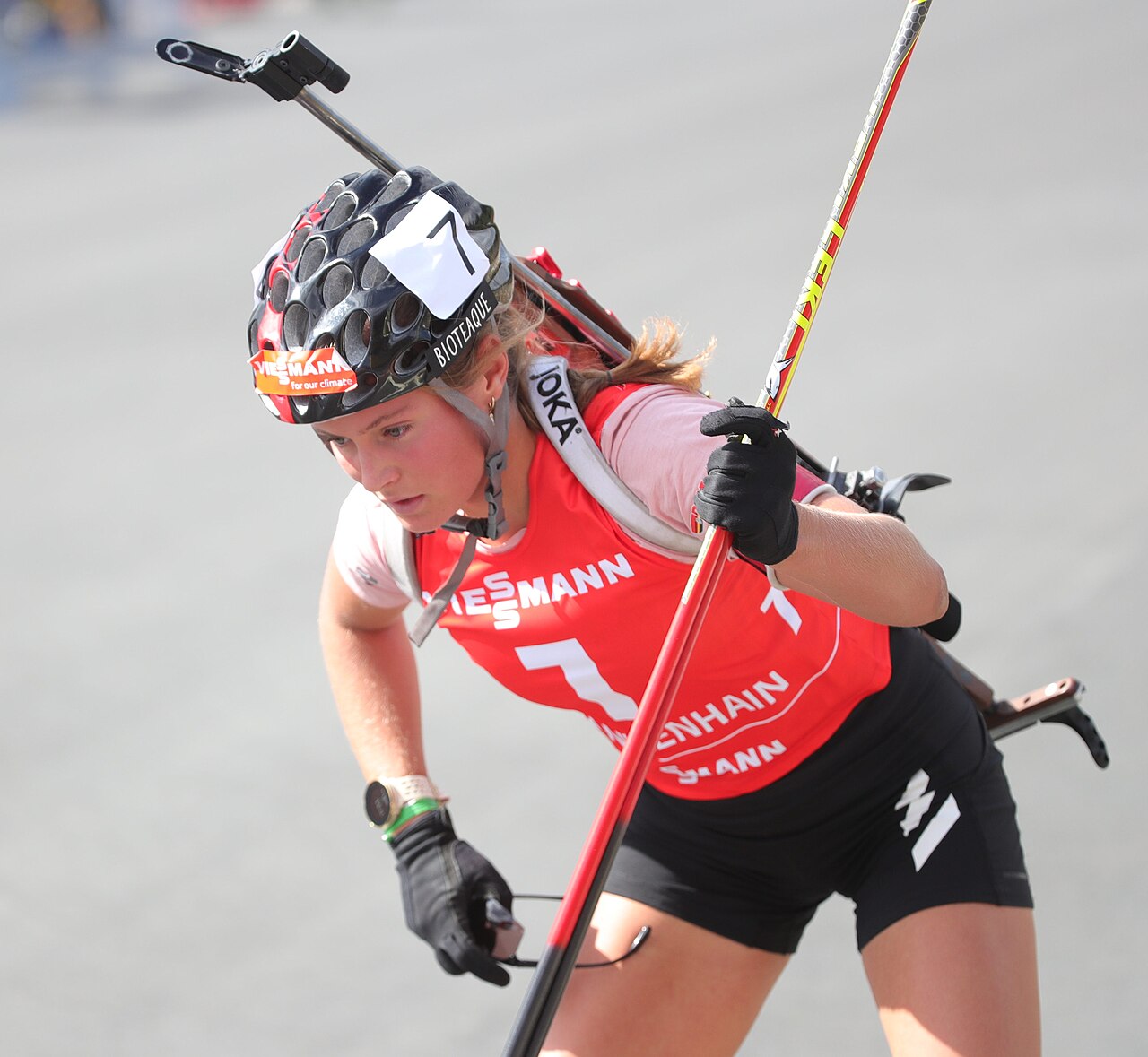
In the demanding world of biathlon, where the raw power of cross-country skiing meets the ice-cold precision of rifle marksmanship, a new star is rapidly ascending. Germany, a nation with a rich legacy in winter sports, is keenly watching the rise of Marlene Fichtner. At just 20 years old (born March 16, 2003), Fichtner has captivated the biathlon community with her meteoric climb, showcasing a blend of natural talent, fierce determination, and an uncanny knack for hitting the targets. Her journey from a promising junior to a World Cup debutante has been nothing short of extraordinary, signaling a bright future for this young German talent.
The Genesis of a Biathlon Prodigy: Marlene Fichtner's Unique Path
Unlike many biathletes who grow up immersed solely in the dual discipline, Marlene Fichtner's path to biathlon stardom took a slightly unconventional turn. She began her athletic career with a strong foundation in cross-country skiing, a sport she pursued alongside shooting from a young age. "I had always done both sports," Fichtner recalls, "but I only started training seriously when I moved to the sports boarding school in Oberhof." This initial focus on endurance sports undoubtedly honed her physical capabilities, providing her with the robust engine necessary for the demanding ski tracks of biathlon.
The pivotal moment in Fichtner's career came in 2021 when she made the definitive switch from cross-country skiing to biathlon. While her skiing base was undeniable, it was her natural aptitude for shooting that truly set her apart. "My strength has always been shooting," she states, a critical advantage in a sport where every missed target can translate into precious seconds lost on the penalty loop. This innate precision allowed her to quickly adapt to the intricacies of biathlon, making an immediate impact in junior competitions. She quickly garnered national recognition in events like the German Schülercup and Deutschlandpokal, securing multiple victories and confirming that her future lay firmly on the biathlon range.
Her rapid progression caught the eye of national selectors, and she quickly transitioned from the junior ranks, proving her capabilities. Training under the tutelage of Andreas Birnbacher in Ruhpolding and competing for the Ski-Club Traunstein, Fichtner's development has been meticulously guided. Furthermore, support from institutions like the Bavarian State Police and her current affiliation with the prestigious Zoll-Ski-Team underscore the professional pathway she has carved out, providing her with the stability and resources essential for elite athletic pursuit.
Conquering the Domestic Front: Germany's Fierce Biathlon Arena
One of the most significant challenges for any aspiring German biathlete is the sheer depth of talent within their own national team. Germany is a powerhouse in biathlon, boasting a relentless production line of world-class athletes. This creates an incredibly competitive environment, as Fichtner herself acknowledges, describing the competition as "brutal."
The intensity of this domestic rivalry is perhaps best illustrated by the selection process for the IBU Cup, the tier directly below the World Cup. While seven athletes might be nominated, only five are ultimately allowed to start a race. "Every athlete gives full throttle, every one wants to run a race," Fichtner emphasizes, highlighting the constant pressure to perform and prove oneself worthy of a coveted starting spot. This rigorous internal competition serves as an excellent proving ground, forcing athletes to consistently push their limits and deliver top-tier performances even before stepping onto the international stage.
Despite this formidable landscape, Marlene Fichtner has not only held her own but thrived. Her "dream start" to recent seasons, marked by multiple podium finishes in Deutschlandpokal races and a convincing victory in the IBU Cup qualification race, speaks volumes about her competitive spirit. She further cemented her standing by finishing fifth in the individual at the German Championships and, notably, becoming the German champion in the pursuit in 2024. These domestic triumphs are not merely personal victories; they are essential stepping stones, demonstrating her readiness to compete at higher levels and securing her place within Germany's elite biathlon development system. It's this relentless pursuit of excellence on home soil that ultimately paved the way for her significant international milestones.
From Junior Phenom to Senior Contender: IBU Cup as the Launchpad
Marlene Fichtner's ascent has been characterized by a systematic progression through the ranks, accumulating invaluable experience and accolades at each stage. Her international debut came early, at the 2020 Youth Olympic Games, giving her a taste of global competition. This was followed by a string of impressive performances at the junior level:
- In 2022, she clinched a silver medal in the relay at the Youth World Championships.
- The 2022/23 season saw her transition to the junior level, where she earned multiple podiums in the IBU Junior Cup, secured a bronze medal at the Junior European Championships, and became a Junior World Champion in the relay – a truly remarkable achievement.
- Her junior career culminated with further success at the 2024 Junior World Championships, where she added two more relay medals to her collection: a gold in the relay and a silver in the mixed relay.
These junior triumphs provided the perfect foundation for her transition to senior international racing. The IBU Cup, often referred to as a "super springboard," proved to be exactly that for Fichtner. Making her debut on the Arber in 2024, she quickly adapted to the increased intensity and competition. She consistently delivered strong performances, culminating in an impressive victory in Geilo during the 2024/25 season. This success on the IBU Cup circuit was not just about winning races; it was about honing her race management skills, adapting to diverse snow conditions, and consistently performing under pressure – all crucial for the next step.
Her dedication and talent were further recognized in the summer of 2024 with her promotion to the German B-National Team. This move underscored her potential and the faith the national federation had in her. The 2025 European Championships in Martell saw her claim her first international medals in the senior category, winning silver in the individual race and a gold with the formidable German relay team. This significant achievement highlighted her readiness to challenge the best in the sport and marked a pivotal moment in Marlene Fichtner's journey from junior gold to Biathlon World Cup contender.
The World Cup Dream Realized: Marlene Fichtner's Ascent to the Elite Stage
All the years of rigorous training, the sacrifices, and the triumphs at junior and IBU Cup levels culminated in a career-defining moment for Marlene Fichtner: her debut in the Biathlon World Cup in the 2024/25 season. This is the pinnacle of the sport, where the world's best biathletes compete week in and week out. For Fichtner, stepping onto that stage was initially about gaining experience. "I just want to get a taste of the experience," she expressed, indicating a mature and pragmatic approach to her first foray into the sport's highest echelon.
The World Cup demands an entirely different level of consistency, mental fortitude, and physical output. The pace is faster, the shooting ranges more unforgiving, and the pressure amplified by global viewership. Her strong start to the 2024/25 IBU Cup season, including a memorable victory in Geilo, ultimately paved the way for her call-up to the World Cup squad, making her debut in Hochfilzen.
For young biathletes like Fichtner, the initial World Cup appearances are often a crucial learning phase. It's about adjusting to the travel, the media attention, the higher velocity of the races, and the razor-thin margins that separate competitors. However, her proven track record of quick adaptation and strong shooting suggests she is well-equipped for this challenge. Her ability to deliver consistent performances and maintain her shooting accuracy under the intense World Cup spotlight will be key to establishing herself as a regular fixture among the elite.
Conclusion
Marlene Fichtner represents the exciting future of German biathlon. Her rapid ascent, from transitioning to the sport in 2021 to making her World Cup debut just a few years later, is a testament to her immense talent and relentless work ethic. With a natural strength in shooting, a history of conquering fierce domestic competition, and a string of impressive junior and IBU Cup victories, Fichtner possesses all the attributes of a future star. As she continues to gain experience on the World Cup circuit, the biathlon world will be watching closely to see how far this promising young athlete can go. Her journey is not just a personal triumph but a source of inspiration, embodying the spirit of dedication and perseverance required to reach the pinnacle of winter sports.